Data sets
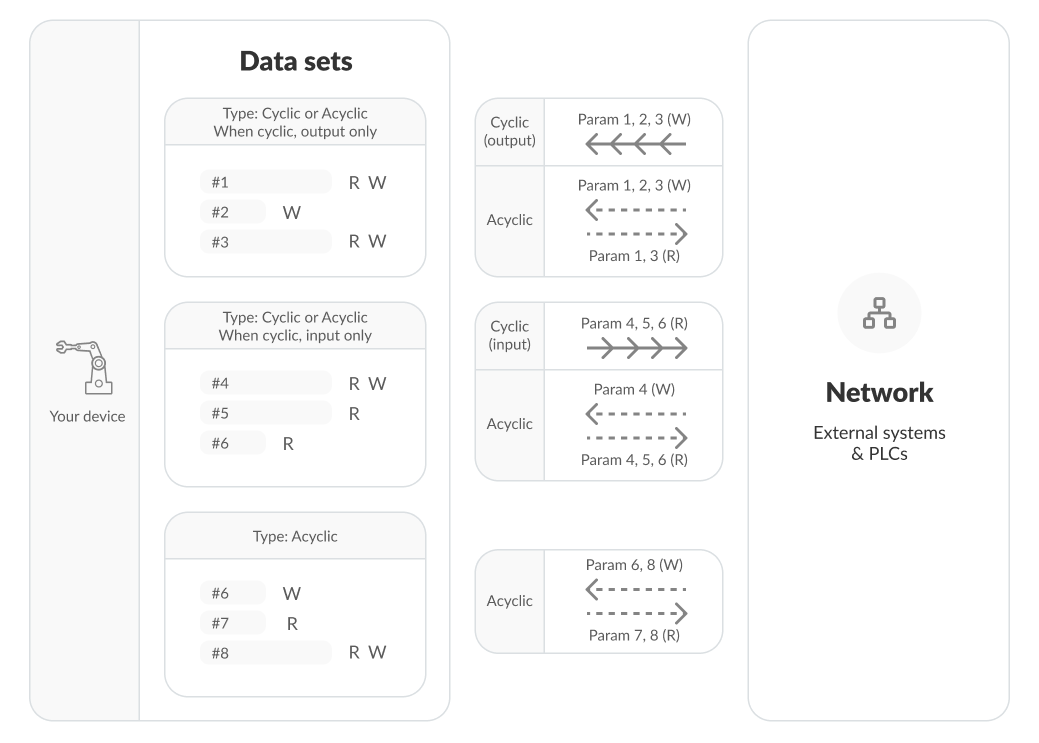
Data sets group parameters into a single, ordered structure that can be transferred as one unit. They are required for cyclic communication and can also be used to organize parameters for acyclic access. Each data set defines a fixed block of data that the Anybus SoM can read or write as a whole
Parameters are individual values. Data sets are grouped parameters with a defined order and layout.
Purpose of data sets
 |
Data sets provide a predictable and consistent structure for communication. For cyclic communication, a data set requires a stable, contiguous data layout. For acyclic communication, a data set is optional; grouping related parameters improves clarity and maintainability.
How data sets work
Data sets are required for cyclic I/O.
All parameters in a data set are updated together.
Cyclic data sets can also be accessed acyclically.
Each data set can be transferred cyclically in only one direction: Input or Output.
Output data sets require an offline action to define behavior if communication is lost: Freeze or Default value.
Data set properties
Number: Each data set is assigned a unique numerical identifier by the Anybus Studio. The number is assigned automatically in sequential order and is used when mapping the data set to industrial network protocols.
Name: A descriptive name for the data set. Use consistent naming conventions, including prefixes, units, and function groups, to simplify navigation in Anybus Studio and external tools.
Content: Defines which parameters belong to the data set. Parameters are transferred in the order listed, and all parameters must use valid, consecutive register addresses.
Cyclic access – direction
Each data set used for cyclic transfer requires a direction:
Input: values transferred from the device to the network
PLC Output: values transferred from the network or PLC to the device
The direction defines how the Anybus SoM interprets the data set and corresponds to I/O direction in other industrial protocols.
All parameters in a cyclic data set must support the selected direction:
Input data sets require parameters with acyclic read (R) access
Output data sets require parameters with acyclic write (W) access
Typical use:
Input data sets: measurements, counters, status values
Output data sets: commands, setpoints, control values
Direction does not apply to data sets used only for acyclic access. In that case, acyclic read/write access is defined per parameter.
Cyclic access – offline action
Input data sets do not require an offline action and are marked N/A. Data sets used only for acyclic access do not use an offline action and are marked –.
Output data sets require an offline action to define device behavior if communication is lost:
Freeze: retain the last valid received values
Use default value: revert all parameters in the data set to their default values
This ensures predictable device behavior during communication loss.